
 Svenska
 Deutsch
Projects
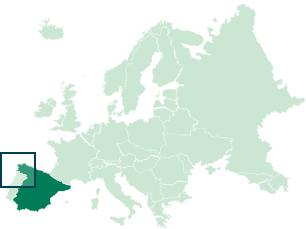
San Juan

Galicia, Spain
42°00'06.8"N 7°10'23.7”W
The San Juan mine is located near the village of A Gudiña – in the province of Ourense in Galicia, Spain. Wolfram – also known as tungsten – is a strategic resource for high-tech industries such as aeronautics, space, and electronics. The proven ore reserves are an estimated 60,000 tons of ore grading 1.3% tungsten trioxide (WO₃) and production is expected to start at the end of 2026.
Read more about the project here
74
W
Tungsten

Exploration
- Reconnaissance drilling
- Geochemistry
- Geophysics
- Mapping

Resource definition
- Infill drilling
- Step-out drilling

Scoping study
- Preliminary technical study
- Preliminary economic study

Development
- Construction
- Commissioning

Production
- Full-scale metal production and delivery
Related news
15 january 2026
Eurobattery Minerals submits CRMA Strategic Project applications for San Juan and Hautalampi
26 november 2025
Eurobattery Minerals secures 30-year extension of the mining license for San Juan to 2055, with full support of the authorities
13 october 2025
Eurobattery Minerals will apply for strategic project status for both San Juan & Hautalampi
04 september 2025
Eurobattery Minerals’ CEO, Roberto García Martínez, has conducted a CEO interview with Mangold Insight
02 september 2025
Eurobattery Minerals’ CEO has participated in a livestreamed company presentation hosted by Finwire Media in conjunction with the ongoing rights issue
01 september 2025
Eurobattery Minerals sends tungsten ore from the San Juan mine for metallurgical testwork
28 august 2025
Eurobattery Minerals commences archaeological studies at the San Juan tungsten project in Galicia
11 august 2025
Eurobattery Minerals begins working in the mine at the San Juan Tungsten Project in Galicia
21 july 2025
Eurobattery Minerals signs former CEO of leading Spanish wolfram project for Tungsten San Juan
14 july 2025
Eurobattery Minerals signs an agreement with Tungsten San Juan S.L. to enter a majority stake in the San Juan wolfram mine in Galicia, Spain
An area well-known for its tungsten resources
The wolfram deposit in the area near A Gudiña has been known approximately since the 1970s.
Apart from the already proven reserves, the potential for a much larger reservoir is geologically high but requires proper investigation guided by the mineralized outcrops and the geologic and genetic interpretation of the reservoir. Estimates set mine life to +12 years, with a total estimated extraction of approximately 910,000 tons of ore. This needs to be confirmed via further explorations and priority will be given to future resource expansion through core drilling.
The price of tungsten has been very stable during the last 10-15 years. But in recent times, the dominance of specific countries and export controls have significantly tightened supply, pushing global prices upward. Rising demand from high-tech, defence, and green sectors – especially electric vehicles and renewable infrastructure – is also placing additional upward pressure on wolfram. The stable and/or rising prices, ensures the profitability of the project.
The importance of wolfram for Europe
Wolfram, also known as tungsten, is a critical raw material for Europe due to its unique properties and strategic applications. With the highest melting point of all metals, exceptional hardness, and high density, tungsten is indispensable in the manufacturing of hard metals used in cutting tools, mining equipment, and high-performance alloys. These materials are essential across key sectors such as aerospace, automotive, construction, energy, and electronics. Tungsten also plays a vital role for the European security and the regions defencecapabilities, where it is used in armour, military-grade components, and heat-resistant materials for aircraft and defence systems.
Read more about the project here
Europe is heavily dependent on imports of tungsten, with over 80% of the global supply coming from China. This creates a significant strategic vulnerability, especially in light of geopolitical tensions and supply chain risks. Recognizing this, the European Commission has classified tungsten as a Critical Raw Material (CRM) due to its economic importance and high supply risk.
Moreover, wolfram supports the EU’s green and digital transitions, as it is used in clean energy technologies such as wind turbines and in advanced electronics that drive innovation. Ensuring a stable and responsible supply of tungsten is therefore essential for Europe’s industrial resilience, technological leadership, and strategic autonomy. To address this, the EU is investing in domestic mining projects, promoting responsible sourcing, and encouraging recycling to secure long-term access to this indispensable raw material.